


May 13, 2026
London Urgently Needs New Homes. Why Can’t It Build Them?
Damian Shepherd
This article by Damian Shepherd from Bloomberg UK has been shortlisted for the 2026 Orwell Prize for Reporting Homelessness.
A short walk from the bustling Ealing Broadway shopping district in one of London’s most populous boroughs, a sign promising the construction of a sleek new apartment development has been quietly removed. Instead, the skeleton of a partly completed building sits abandoned. Work has been stalled for almost three years following the sudden collapse of the contractor, whose inability to cover its rising debts and soaring costs wiped out plans to build more than 100 new affordable homes in the area.
London urgently needs more housing. The city’s population has increased by over half a million in the decade through 2023, bringing it to around nine million, yet homebuilding has fallen dramatically. Thousands of projects have been cancelled or indefinitely paused in the past half-decade, and ground was broken on only 5,547 residential homes last year — a drop of more than 75% from a decade earlier and the fewest in at least 15 years, according to Molior London, which tracks the sector. In coming years, the gap between supply and demand is only expected to grow.
“Of all the markets, London is the most challenging in terms of getting things built,” said Gemma Kendall, head of living investment at broker JLL.
London’s homebuilding crisis came about through a mix of economic and bureaucratic factors which accumulated over time, slowly scrambling the math for developers. Thanks to pandemic- and Ukraine-related supply chain shocks, which have driven up the prices of materials, and to Brexit, which has reduced the pool of available workers, construction costs have consistently risen for about six years. Meanwhile, as interest rates have crept higher, a bloated regulatory system has slowed building approvals and delayed home completions.
“The housing sector has faced a perfect storm of national and global pressures,” said James-J Walsh, an elected local representative in Lewisham, a suburb of London, which recently scrapped plans to build dozens of homes after a contractor went bankrupt. Margins are now so thin, he said, that “any financial or regulatory shock” can threaten a project.
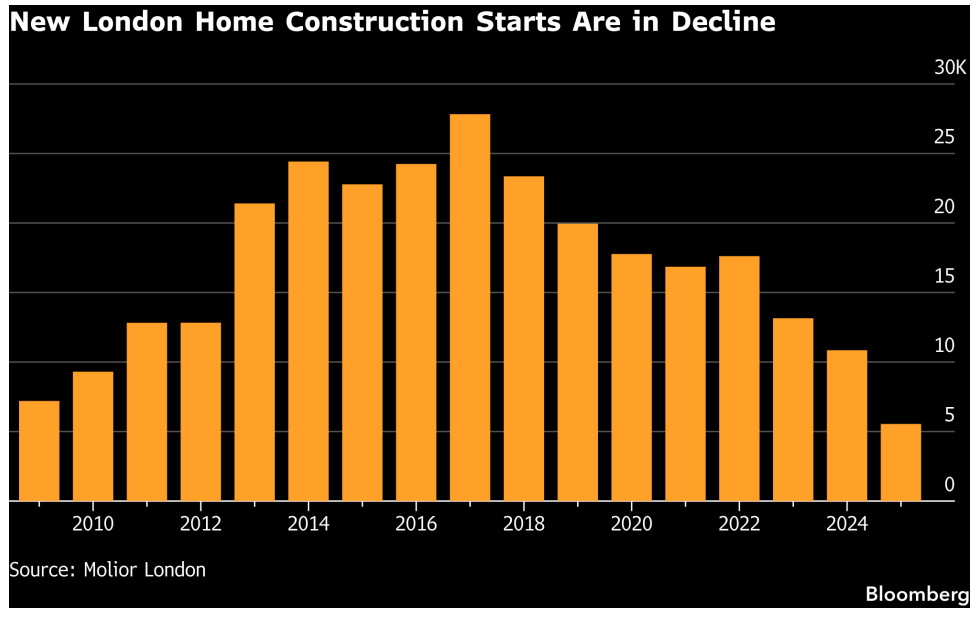
On the buyers’ side, the lack of new buildings has driven up prices and made housing costs one of the top political issues in the UK.
“Homes are, on the whole, not affordable for Londoners,” said Anna Minton, a Reader in Architecture at the University of East London. The median salary in London is about £48,000 a year for full-time employees, according to data from the Office for National Statistics, while the average apartment costs £430,000. With mortgage rates averaging about 5.5%, it would take the average London couple more than 12 years to save for a 20% deposit on a first home, according to Hamptons, a broker.
Building contractors tend to be the early warning system for the housing sector, as they’re often the first to be hit with higher labor and supply costs. And in recent years, signals have been flashing. While managing cash flows and construction schedules is challenging under the best of circumstances, the added pressures of supply chain tangles, spiraling inflation and worker shortages have been fatal to many. Construction firms accounted for 17% of insolvencies in England and Wales in 2025, according to government statistics, the most of any sector.
Builders’ troubles are also working their way through the value chain. Over half-a-dozen developers with stalled projects in London told Bloomberg that delays were the result of contractors going bust. As of the end of December, work had come to a halt on more than 5,000 homes across London, according to Molior, more than double than in 2020. Many of these, the data show, were caused by bankruptcies.
While many struggling contractors are family- or owner-run, larger concerns are also taking a hit. Henry Boot Plc, one of the UK’s leading developers, sold its more than 50-year-old construction business in December. “The margins are very, very fine,” Chief Executive Officer Tim Roberts explained in an interview after the sale was announced, adding that he “did not have the stomach” to scale up the business.
Other big companies are coming to similar conclusions. John Lewis Partnership Plc, which controls chains of popular supermarkets and department stores, shut down its build-to-rent property business this year, blaming higher interest rates and labor costs. That decision also meant the end of its plans to build about 1,000 homes across London and its commuter belt.
“When a brand as well-known and well-resourced as John Lewis concludes that the economics no longer work, ministers need to sit up and think very carefully,” said Brendan Geraghty, chief executive officer at the Association for Rental Living.
This wasn’t the case five years ago. During the pandemic, lower borrowing costs and the government-backed Help to Buy program, which offered first-time homebuyers equity loans — and, critics say, contributed to skyrocketing home prices — stoked housebuilding and turbocharged developer profits.
Then in 2022, the Bank of England began hiking interest rates, turning the cheap money tap off. Suddenly, not only were mortgages more expensive, but developers had to pay more for loans to finance their projects. And with the cost of capital higher, said Tom Goodall, chief executive at Related Argent, the developer behind the more than £3 billion ($4.1 billion) revamp of London’s King’s Cross, “the risk-return required is very different.” In this more cautious environment, he added, “developers want to protect their profit margins.”
Doing so can be something of a high-wire act. Historically, land accounts for about a third of the eventual sales price on residential projects, but it can be significantly higher in dense urban areas like London. Developers typically target a profit margin of between 20% and 25%, which increases during moments of uncertainty, as investors want larger returns for taking on more risk. So when construction costs go up, or red tape leads to delays, developers must sell at much higher prices to make the projects financially viable. In London, however, with buyers already stretched to their limits, prices often can’t go up any further — and so construction ends up stalling. And with land in the capital still very much in demand — for hotel or office development, if not for homes — land value hasn’t fallen as much as might be expected.
Another chilling factor in the overall equation is building regulation, which has gotten more restrictive since 2017, when a fire in a West London high-rise killed 72 people. In the wake of the Grenfell Tower tragedy, lawmakers passed measures stipulating that buildings taller than 18 meters with at least some residential units now need to pass three inspections — known as “gateways” — before regulators can sign off. The UK’s Building Safety Regulator, however, has acknowledged that it doesn’t have enough employees to quickly process these filings, turning the gateways into something like chokepoints. The resulting backlog has extended construction timelines and incentivized developers to take on less ambitious residential projects.
Greystar Real Estate Partners, one of London’s most prominent build-to-rent investors, experienced this firsthand last year, when a rental tower it was building in London’s Battersea district was subject to severe – and expensive – delays totaling many months. The US private equity firm, which manages more than $300 billion of real estate globally, is now focusing on low-rise residential projects.
“The taller you go,” said Thomasin Renshaw, managing director of UK development at Greystar, “the more it costs you to build.”
The UK’s housing associations, which act as developers and landlords for large social housing projects and oversee roughly 10% of Britain’s housing stock, are also struggling. Clarion Housing Group Ltd and Southern Housing, which collectively manage more than 200,000 homes, have seen hundreds of homes stalled in the past year. That’s because the wider housing association sector accumulated vast piles of debt during the cheap money era, which private housing providers are now struggling to pay. In the year through March, government accounts show that the cost of servicing that debt was greater than providers’ net earnings after maintenance costs.
All this has stymied the plans of the Labour government, which promised to add about 300,000 affordable homes across England over the next decade when it came to power in 2024.
Mayor of London Sadiq Khan and Housing Secretary Steve Reed wrote to housebuilders this week laying out a series of proposals to “help unlock stalled schemes.” Those include time-limited changes to planning rules, tax breaks for developers and granting the mayor new power to overrule local officials.
“A lack of housing supply has serious impacts, with one child in every average London classroom living in temporary accommodation,” Khan and Reed wrote to housebuilders. “We now ask you to review your pipelines and identify schemes that can benefit.”
Solving London’s housing crisis is more complicated than simply constructing more units, said Anna Milton, who is also the author of Big Capital: Who is London For? Rather than see homebuilding as a way to juice GDP growth, she believes that the government needs to build “genuinely affordable social housing” and to subsidize housing, as it used to do in the past. With expensive homes in London sitting empty, she said, the political debate is “focusing on the wrong things. We are focusing on housing numbers rather than affordable homebuilding.”
As this plays out, there are signs that homebuilding could begin to pick up. With homebuilding incentives set to come into effect soon, some UK developers are striking an optimistic tone. The government is considering introducing an equity loan program for new-build homes this year, according to people familiar with the matter, and a survey published last month by broker Knight Frank found that an ease in regulatory delays has led more people to inquire about land purchases in recent months.
For now, the slump in demand is forcing some developers to sell homes in bulk — a last-resort tactic that cuts into profit. For local authorities, however, that can have a silver lining. In Ealing, the council recently took advantage of the “challenging market conditions” to buy 290 units this way. With more than 7,000 families in the borough in “urgent need” of a home, they’ll be rented out as social housing.
This article was originally published on Bloomberg UK.


