


June 24, 2026
Introducing the faith and homelessness initiative
Revd Ian Rutherford
Preventing homelessness is a legal responsibility. The duty sits primarily with local authorities but, as the Government’s National Plan To End Homelessness makes clear, all of our public services have a key role to play if we are to embed prevention upstream.
Nor should this be solely the task of the state. Civil society has a long tradition of preventing and relieving homelessness. If we are to treat the homelessness crisis with the urgency it deserves, communities should reflect on the role they can play.
If we are to achieve systemic, lasting change, we must engage with the networks that operate daily on the frontline of community care, with roots deep in communities right across the UK.
It is with this in mind that I am proud to introduce a new initiative we are calling Faith and Homelessness. Our developing mission statement is as follows:
In a time of hardening public narratives and increasing division, leaders inspired by the Christian faith in homelessness must provide a clear voice of hope and moral clarity. We are building a movement to inspire a new national agenda — a defining statement on prevention — that moves us from filling the gaps to shaping the solutions. We seek your leadership, and prayers, to design that shared vision and the action required to mobilise all parts of society in our joint goal.
The power of untapped civic infrastructure
To understand the context and objectives of this initiative, we have to look at the unique institutional assets that faith communities bring to the table. These are not just groups of well-meaning individuals; they represent a massive, deeply embedded network of social infrastructure.
They possess immense human capital. They command mobilised, highly motivated volunteer forces capable of sustaining long-term, localised support structures. Importantly, churches hold deep relational capital. They exist in precisely the spaces where state services have often retreated, holding trust with marginalised populations who are otherwise entirely disconnected from traditional support systems.
And, of course, churches possess significant physical capital. Across every town and city in the UK, these groups own and manage buildings, halls, kitchens, and spaces that are uniquely positioned within local neighbourhoods.
It is, however, important to acknowledge that despite centuries of work to tackle homelessness, too often faith organisations are pulled towards crisis response rather than heading upstream to prevent homelessness before it blights people’s lives.
I feel passionately about this initiative because we are already combining the evidence-based practices of organisations like the Centre for Homelessness Impact with this existing infrastructure. It is my hope that we can pivot frontline delivery toward interventions that are proven to break the cycle of homelessness permanently, and to lay down a moral challenge to the scourge of homelessness that no other group can.
Countering a divided society
Faith and Homelessness arrives at a critical juncture. We are living through an era defined by an increasingly fragmented public square and a deeply divided society. Social cohesion is under immense strain, and the polarisation of public discourse frequently paralyses collaborative action. I fear that hardening public attitudes could even lead to more punitive and damaging approaches to tackling homelessness, rather than actually trying to solve it.
When society fractures, the safety nets disappear, and the most vulnerable individuals fall through the gaps first. The Faith and Homelessness initiative is explicitly designed to counter this drift. By building a robust, shared framework between secular housing experts, local authorities, and diverse community leaders, we are creating a rare space of common purpose that will have a unique ability to talk across divides. This is about establishing a unified front against a pressing social crisis, proving that shared values can triumph over ideological division.
The story so far: Building the coalition
Over the past year, we have quietly and systematically brought together key leaders from civil society, statutory services, and various church and community networks. These preliminary gatherings have focused on mutual listening, understanding where existing efforts duplicate or conflict, and identifying how faith communities have the potential to work together to prevent homelessness and bridge divides. The energy in these rooms has been remarkable. There is a profound, shared hunger to move past short-term crisis management and towards strategic prevention.
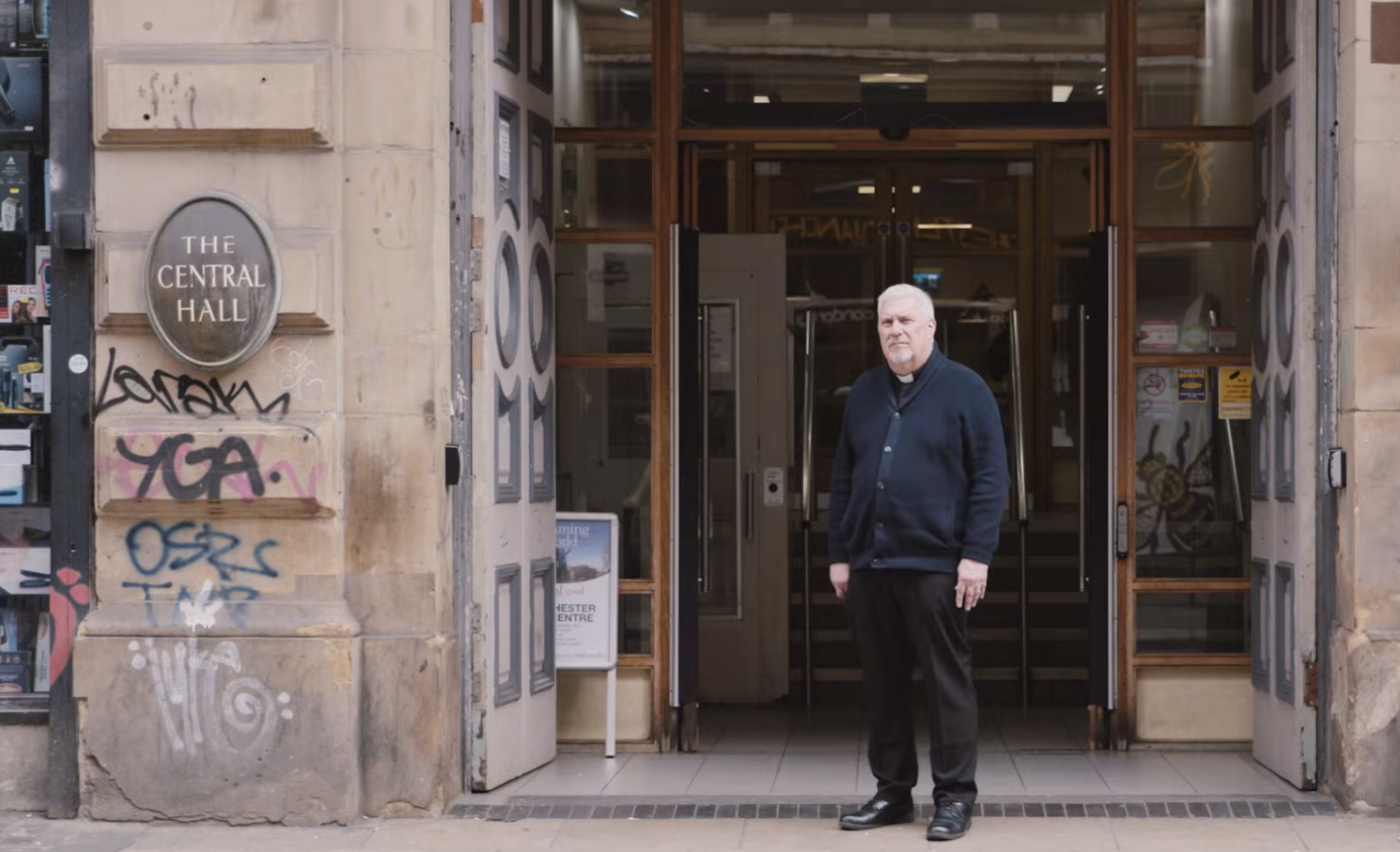
Ian Rutherford introduce the Faith and Homelessness initiative.
Looking ahead: A new blueprint and a national summit
We are currently laying the groundwork for a landmark report. This publication is in part inspired by two important past publications on faith and social action. One is the Faith in the City report, produced in 1985 by a commission on urban priority areas set up by the then Archbishop of Canterbury, which created a national debate about the decline in inner cities, challenging both the mission of the Anglican Church and national government. The second is The Common Good published by the Catholic Bishops Conference in England and Wales in 1996 to set out principles of social justice ahead of a forthcoming general election.
Just as those pieces of work fundamentally reframed the national conversation around poverty and structural neglect, our upcoming report will provide a modern blueprint and theological framework for how faith communities can take more radical action to prevent homelessness.
And to launch these findings and solidify this coalition, we are organising a national summit. This event will bring together faith organisations and church leaders with policy innovators, sector experts, and community facilitators to demonstrate our shared commitment to preventing homelessness.
We look forward to sharing more details with you in the coming months as we work to turn this vital social infrastructure into one of our most effective tools for ending homelessness once and for all.
- The Revd Ian Rutherford is City Centre Minister at Methodist Central Hall Manchester


