



May 13, 2026
Domestic homicide: what can housing learn when the worst happens?
Katharine Swindells
This article by Katharine Swindells for Inside Housing has been shortlisted for the 2026 Orwell Prize for Reporting Homelessness. This is an excerpt from the full article which can be viewed here.
Content warning: this article contains details of murder, suicide, domestic abuse, drug use, and other themes that may be upsetting for readers.
“I am so grateful for the life I have without him… Now I am able to do things I want to do, things to keep me busy and a chance to do the things I dreamt and imagined with all my children, building my own independence.” These were the words of Marie* in July 2014, when she was pregnant and living in a women’s refuge, and her abusive ex-partner Lee* was in prison awaiting sentencing. He had been arrested on suspicion of rape, unlawful imprisonment and threat to kill.
When the police found Marie, she weighed five-and-a-half stone – starved, gaunt and trembling. But in the few months since Lee’s arrest, Marie had been clean from drugs, and was excited about her future and the baby. As she said: “I am looking forward to having my own home eventually, to decorate it and bring up my child in a happy and safe place.”
But Lee was given a suspended sentence and released with no restraining order. Marie stopped engaging with support and health services and four days after the birth, her child was removed into foster care.
Marie became a Sandwell Council tenant, but while over the years she was flagged for financial assistance, anti-social behaviour and drugs complaints, the council’s housing department did not make the connection that her boyfriend was Lee, the same man who had been charged with abuse against her a few years before. Housing officers were warned that he was violent and aggressive, but did not note the potential risk to Marie.
In November 2018, housing staff assisted the police in a drugs raid on the property, during which weapons were found. But, again, the danger to Marie was not considered. In December 2018, Marie’s sister called the police because Marie had not shown up for their family Christmas. When the police forced entry to Marie’s flat, they discovered her body. She was 33 years old. Lee pleaded guilty to murder and was sentenced in late 2019.
Marie’s story is taken from the domestic homicide review, commissioned by the Safer Sandwell Partnership following her death. Inside Housing read her story as part of our analysis of 76 public domestic homicide reviews to find learnings for the social housing and homelessness sector.
A domestic homicide review is a statutory multi-agency process taken after a death (either killing or suicide) that has, or appears to have, resulted from violence, abuse or neglect by their intimate partner, relative or household member.
Also known as a ‘domestic abuse-related death review’, or DARDR, the review is undertaken by the local community safety partnership with an independent chair to examine all statutory agencies which had contact with the victim or perpetrator and look at the history of abuse. The goal of a review is to identify lessons learned for statutory agencies and reduce the risk of future such tragedies.
The reviews, which are published online, produce learnings and recommendations for, most commonly, the police, adult social care, NHS trusts, mental health services and other organisations. In many cases, the reviews find missed opportunities where social housing providers and homelessness services could or should have acted differently, as is the case with Marie. The goal of this is not to drag up traumatic memories for communities, or to name and shame housing providers, but to identify opportunities for learning.
“Someone’s death is a tragedy, but that learning can be disseminated and embedded to support everybody, to prevent repetition and to highlight good practice,” says Cherryl Henry-Leach, chief executive of the charity Standing Together Against Domestic Abuse, who also acts as an independent chair for domestic homicide reviews.
Out of around 200 public domestic homicide reviews for deaths between 2017 and the present, 76 victims (38%) had been logged as having a ‘housing vulnerability’. Inside Housing analysed all 76 of these reviews. We found that 42% were suicide or an overdose with a history of abuse in the victim’s life and 55% were a homicide, nearly three-quarters of which were intimate partner homicide. More than half of the cases involved drugs or alcohol abuse or addiction by either the victim or perpetrator.
More than three-quarters of the victims were women. Among the 12 homicides of men, the majority of perpetrators were male family members, such as a brother, father or son, and four were killed by a female partner. In all of these four cases, there is evidence that the man who was killed had perpetrated abuse against the woman, or they were both abusive to each other. We found that nearly two-thirds (49) of cases had lessons specifically for the social housing and homelessness sector.
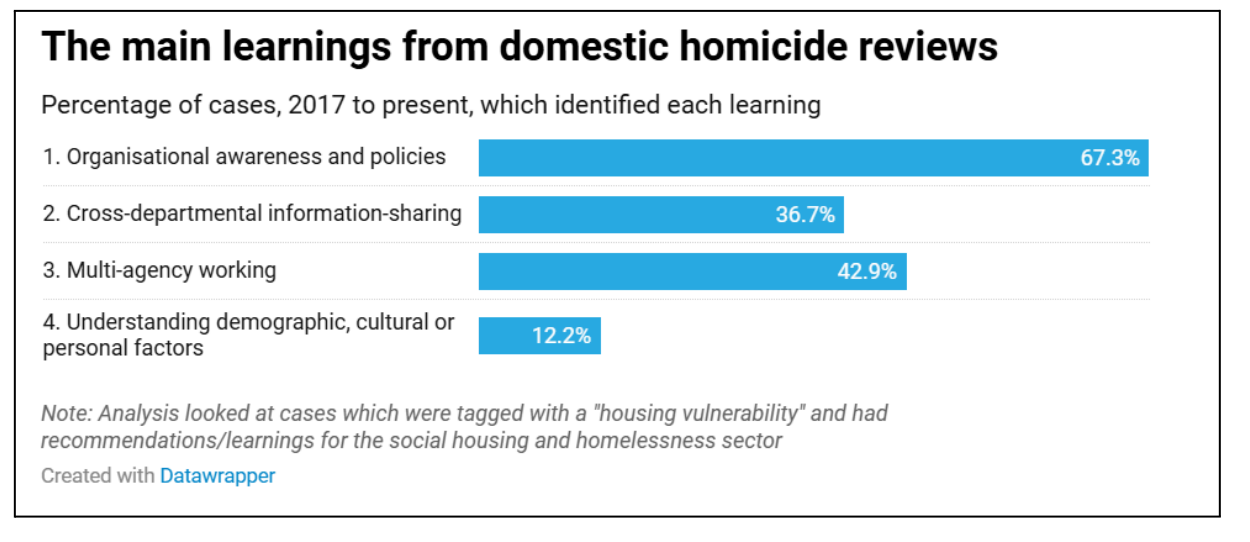
We categorised these learnings into four key themes:
- Organisational awareness and understanding of domestic abuse policies
- Cross-departmental awareness and information-sharing
- Multi-agency working with local services
- Understanding demographic, cultural or personal factors that might impact a victim seeking help
In this article, Inside Housing will explore each of these themes.
Ms Henry-Leach has been working in the domestic abuse sector for a long time – “what feels like since the ark was built”, as she puts it. First she worked in frontline roles, then later as deputy chief executive of the Advocacy After Fatal Domestic Abuse organisation, and now she is chief executive of Standing Together Against Domestic Abuse.
“As a DHR [domestic homicide review] chair, we’re probably the last people to formally showcase the victim’s journey,” she states. “It’s a huge responsibility, and one that I forever find challenging but also humbling.”
The purpose of a domestic homicide review is, she says, to establish what changes agencies need to make to mitigate the risk of a similar event happening again. As a review chair, Ms Henry-Leach says her role is to help the panel avoid “hindsight bias” and embrace the learnings of the process.
“Having been a frontline practitioner myself, sometimes it’s really hard for practitioners to see beyond your role,” she explains. “So having that experience front and centre when I’m leading on reviews also helps me move away from that blame culture and the hindsight bias.”
Dr Kelly Henderson is co-founder of the Domestic Abuse Housing Alliance (DAHA), a specialist organisation supporting housing providers to improve their response to domestic abuse. She says social housing can play a crucial role in recognising domestic abuse and preventing domestic homicide.
“We’re in the ideal space because we are in people’s properties and we develop rapport with people, they often trust us more than statutory agencies,” she says. “It’s that early recognition that’s required, so if we spot something going on, we’re ideally placed to make a difference.”
You can read the full article that was originally published in Inside Housing.


